Saturday, April 20, 2013

Movement I - Measures 30 to 38

Before examining the scoring of this passage, I want to examine the passage itself in a bit more detail than usual.


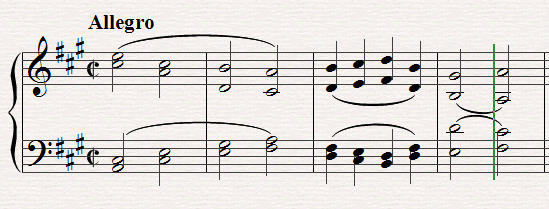
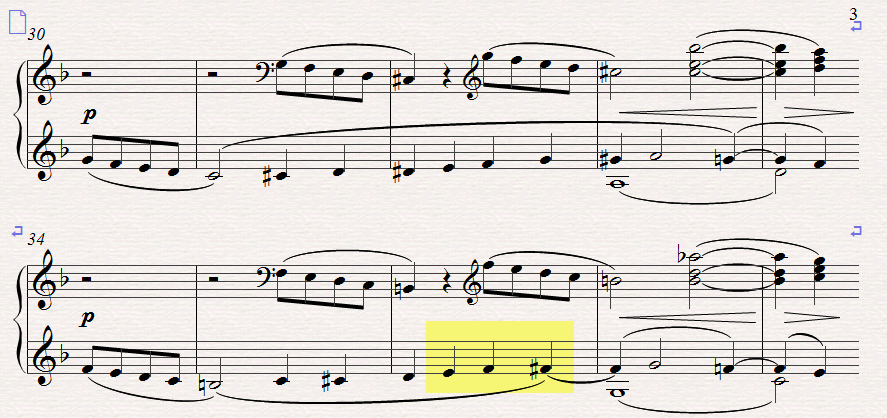
These eight measures are essentially a repetition of the previous eight measures with a different accompaniment. But the repetition is not exact. Beethoven alters the melody of the second phrase. If the repetition were exact, the second phrase would be as follows:


Why does Beethoven change the melody? To maintain good two-part counterpoint. The second highlighted note in the unaltered version is an E. In the soprano, we have an F (an appoggiatura) resolving to E. When a dissonance resolves to a note that is already present in another voice, it is called "anticipating the resolution." This is OK in two-part texture when the resolution is to the tonic or to the fourth or fifth degree of the scale (as it is in phrase A) but not when the resolution is to the third degree of the scale. Our modern-day ears aren't so sensitive to such niceties, since they are used to hearing much worse. But, to Beethoven, the above passage would sound noticeably weak. So he changes the melody to avoid the problem.

That means the melody reaches its goal, F-sharp, one beat early, so he ties the F-sharp to the downbeat of the next measure. This problem does not occur in phrase A, so Beethoven leaves that phrase unaltered.

Why am I going into all this? Because Beethoven does something interesting in his string arrangement. He decides to alter both phrases:


As you can see, he changes the melody of phrase A to match phrase B. In addition, he changes the first C-sharp in the right hand to a C-natural, which works better with the altered melody.

I can't imagine there is anything specific to string writing that prompted the decision to alter phrase A. I think Beethoven just decided he liked the theme better this way, and rightly so. Changing only the second phrase makes it appear that the change is one of necessity. Changing both phrases makes it appear voluntary, as if variety were the sole consideration. It's the musical equivalent of putting the awkward rhyme first in a rhymed couplet so as not to draw attention to it. Bach, whom Beethoven consciously emulated, did this sort of thing frequently.

Back to Beethoven's scoring decisions. Here is the literal transcription:


And here is Beethoven's arrangement:


It surprises me that Beethoven chooses to give the melody to the second violin rather than to the viola, not so much because it requires crossing parts in measures 33 and 37 but because we just heard this melody played by the first violin. So I would have expected Beethoven to give this utterance to the viola for a change of color.

As he has done previously in this movement, Beethoven replaces the half notes in the cello at the end of each phrase with staccato quarter notes, giving the downbeats an extra fillip.

Finally, Beethoven has the viola double the first violin's entrance in measures 32 and 36 a tenth below. Simply having the viola jump in at the last minute to assist with the chords at the end of the phrase would sound a bit abrupt. This change makes for a smoother transition into the cadence. The quarter-note rests are, of course, necessitated by the fact that the violist must skip over a string to reach the high notes.

Saturday, April 13, 2013

Movement I - Measures 22 to 30


Measure 22 begins the secondary theme. The literal transcription is straightforward. 


But Beethoven, as usual, is not content with a literal transcription. In the the piano version, the accompaniment offers a contrast to the melody. It consists of chords on the strong beats against the syncopated melody.

In the string version, the accompaniment serves more as a complement to the melody. The lower strings play a counter-melody in thirds beginning on the first beat of measure 25 and moving in contrary motion with the first violin. At the end of the measure, the second violin joins the first violin in thirds.


Thirds or sixths in contrary motion produce a smooth, gentle sound in strings. Mozart used this technique to good effect in the opening of his Clarinet Quintet:


This change, therefore, emphasizes the contrast between the rising staccato line that begins the phrase and the legato cadence. This contrast is present in the original version, but it is less apparent. The string version brings the contrast into higher relief. After hearing this version, I'm sure that, when I play this sonata, I will play this passage differently.

Beethoven continues to follow his practice of articulating the downbeats more clearly in the string version. He replaces the half notes in measure 26 with quarter-note staccatos, and he eliminates the tie in the melody. Of course, this change is more subtle on the violin than it would be on the piano. There is a big difference between having the hammer strike the string again and simply changing direction of the bow. So the effect of repeating the G, especially when combined with retaining the tie in the second violin part, is simply to give an extra pulse to the downbeat. When the phrase repeats, however, Beethoven is not content with this extra pulse. In measure 30, he emphasizes the re-articulated F by adding a turn.


Saturday, April 6, 2013

Movement I - Measures 16 to 22

Beethoven makes quite a few changes in measures 16 to 22, the end of the modulating bridge:


In my transcription, I had to raise the tenor part an octave to keep it in the range of the viola. And I had to make some adjustments to the chords at the end. But this is reasonably close to the piano version.

xxx
The most noticeable change Beethoven makes is to abandon the alternating dynamics. In the piano version, these alternating dynamics throw you off balance by emphasizing beat three of each measure. In the string version, he accomplishes the same thing by adding a sforzando in all four parts to beat three of each measure.

He also makes something explicit in the string version that is only implicit in the piano version, namely that the odd and even measures are identical except for revoicing. That is, the four beats beginning with beat three of measure 18 are identical to the preceding four beats except that the parts are switched around. The first violin takes the viola part an octave higher, the second violin takes the first violin part, and the viola takes the first violin part an octave lower. You can hear this in the piano version even though some notes are left out, most notably the sixteenth notes in measure 18.

Another change Beethoven makes is to increase the tension by bringing the repeated Gs in the bass up an octave in measure 19, then up another octave in measure 20. And, at the the end of measure 20, he effects the climax by articulating the sixteenth-note figure in all three upper parts. You couldn't really do this on the piano unless you had seven fingers on your right hand.

If you listen to both samples, you can hear that the transcription sounds smoother and less animated. This is partly due to the sforzandos in Beethoven's arrangement. But it is also due to the added rests. The inner voices in the piano part and the transcription are mostly half notes. In the arrangement, Beethoven ends the sixteenth-note figure in the alto part with a staccato and a rest. He also adds a rest to both inner parts at the beginning of measure 19. This isn't really practical on the piano, but it gives a much cleaner sound in strings.

Finally, we have the two punctuating chords at the end, which Beethoven now marks as fortissimo. Of necessity, he must raise the bass part an octave. Perhaps this is another reason Beethoven chose to bring the cello part up in the preceding measures, since it allows a dramatic two-octave descent to the low G. Beethoven also raises the soprano an octave in the first chord, allowing a forceful quadruple stop in the violin part. In the final chord, the middle voices are dropped, leaving octave Gs, a change sufficiently obvious that I employed it in my "literal" transcription as well.

All in all, the string version of this passage is much more effective than the piano version. One senses Beethoven had this version in mind from the start and made concessions when he wrote the piano sonata.


xxx

Friday, March 29, 2013

Movement I - Measures 13 to 16

Measure 13 begins the modulating bridge:


The tenor voice drops below the range of the viola. So, in the transcription below, I have raised the tenor voice an octave. As in the opening of the movement, I ignored the octave doublings on the third beat of measures 13 and 14.


The audio sample backs up to measure 12, so you can hear how measure 13 is approached.

Beethoven, in measures 13 and 14, gives the tenor part to the second violin and has the viola doubling the cello an octave higher. Presumably the open tenth in my transcription was not the sound he wanted, so he used this technique to preserve the thirds. Also, as at the beginning of the movement, he adds a chord to the downbeat, providing a smoother transition from the previous measure. Unlike at the beginning of the movement, he uses the same chord on this beat as in the rest of the measure. That suggests his reason for included the chord was not so much to articulate the downbeat as to provide continuity..

Note that he has the viola play an F on beat three of measure 13 even though the second violin and cello have a rest, thus slipping in the octave doubling of the melody in the piano version. A nice attention to detail.

In measure 15, he abandons the eighth-note chords of the piano version and keeps the eighth-note motion only in the cello, which produces a cleaner sound. He also chooses to double not the melody but the middle voice.

Finally, he adds a rest to the cello part in beat three of measure 16. Perhaps he felt the sforzando provided sufficient articulation to this beat. In the piano, the sforzando is not possible, so he included the F-sharp in the bass for extra emphasis.


Sunday, March 24, 2013

Movement I - Measures 9 to 12

In measures 9-12, Beethoven adds a fifth voice at the end of each phrase.

The easiest way to score this is to have the viola play the bottom two voices in measure ten (allowing it to use the open C string for the double stop), which means giving the cello the middle voice (F to E). When the phrase repeats an octave lower, the cello can take the double stops. Thus a literal transcription would look like this:


Beethoven's actual arrangement is as follows:


In measure nine, Beethoven leaves out the alto voice. This allows him to end the preceding phrase with the staccato chord in the second violin and viola as discussed in the previous post. But it also accentuates the contrast between this measure and the following measure. We now move from a two-voice texture to a five-voice texture. He further accentuates this contrast both by adding a crescendo in measure ten (dropping back down to piano when we revert to the two-voice texture) and by moving the entrance of the fifth voice from the third beat of measure ten to the first beat. (Although practical considerations might have something to do with this change as well. I imagine the viola part is easier to play this way.)

At the beginning of measure 11, he adds an A in the second violin part that is not present in the original. This makes for better chord spacing. Probably the only reason he did not have this A in the original was that in was not possible on the piano (at least not if he wanted half notes in the alto part).

In the last measure, he drops the fifth voice altogether, keeping the low C but eliminating the chromatic line B-B flat-A.  Presumably Beethoven thought retaining the line in this register would sound muddy, especially when the lower two voices resolved to a third at the beginning of measure 13.

Saturday, March 16, 2013

Movement I - Measures 5 to 8

Measures 5 -6 seem straightforward enough to transcribe:


These measures almost make you wonder if Beethoven was thinking in terms of a string quartet when he originally wrote the sonata. If so, perhaps that's why he chose this particular sonata to arrange.

Curiously, Beethoven does make one change to these measures. In the viola part (first half of measure six), he adds a staccato to the quarter-note C. Why this C and not the corresponding Cs in the violin parts, I wonder. Is it a misprint?

Measures 7-8 are as follows:


Again, this is straightforward four-part writing. In the transcription audio below, my only changes were to the pianistic ornaments. I eliminated the arpeggio at the start of measure eight, and I executed the turn before the beat rather than on the beat as notated (since executing the turn in the first violin while the second violin was playing a unison C would sound muddy).


Beethoven's arrangement of these measures is as follows:


Beethoven also moved the turn before the beat. But instead of simply eliminating the arpeggio, he added a fortepiano to the cello part, which has a similar effect. Perhaps he would have written a fortepiano to begin with if the piano were capable of executing it.

He also strengthened this beat by adding a staccato chord in the second violin and viola and changed beat four of the previous measure to lead into this chord. He added an E in the second violin part to lead into the F. And, once he had the upper two parts moving on the last eighth note, it made sense to have the viola part moving on the last eighh note as well for a better ensemble sound. Thus he change the quarter-note B-flat to C followed by B-flat. These same changes occur at the end of measure eight.

One final change is to eliminate the tied C in the melody going into measure nine. He adds a staccato to the eighth-note C in order to rearticulate the C on the first beat of measure nine. So far, many of Beethoven's changes seem to consist of ensuring a firm articulation of the first beat of each measure.

You can hear the effect of Beethoven's changes below. I faithfully rendered the curious staccato in measure six. You can decide for yourself if it adds anything. 


Friday, March 15, 2013

Movement I - Measures 1 to 4

In the late 18th century, the most common way for music-lovers to enjoy music was not to attend public concerts but to play it themselves. Amateur string quartets, for example. would often gather in members' homes to play through new pieces. And they did not restrict themselves to works originally written for string quartet. They also enjoyed playing arrangements of popular works of other genres. To accommodate this demand, publishers hired composers to make such arrangements

In 1801, in the wake of the popularity of Beethoven's opus 18 string quartets, Beethoven's publisher asked him to arrange some of his piano sonatas for string quartet. Beethoven began the project but stopped after only one arrangement, namely, of his Piano Sonata No. 9 in E Major. Perhaps he found the task to be too onerous, since he wasn't content merely to transcribe the sonata. He meticulously made changes to the music in order to render it more idiomatic for strings. He was quite happy with the end result, however. He bragged in a letter to his publisher that, aside from himself, only Haydn or Mozart could have managed it.

I thought it would be helpful for my own development as a composer to go through this arrangement in detail to see what changes Beethoven made. I could compare a literal transcription of the music with Beethoven's arrangement and ask myself why he made the changes that he did. If one wants to learn how to write a string quartet, what better teacher could one have than Beethoven himself? It would be nice to have my own personal ensemble to play through both versions for me so I could hear the differences. Unfortunately, I don't have that luxury. But I can come pretty close to reproducing that experience with Cubase and Sounds Online Symphonic Gold samples. Since this exploration might be of interest to other composers, I have decided to record it in this blog.

The first change Beethoven made was to raise the entire sonata a half step to the key of F Major. The reason for this change is obvious enough. All twelve open strings belong the key of F Major. Only three of the twelve belong to E Major. So double and triple stops will be easier in the new key. In addition, the transposition makes it easier to use the lowest register of the cello, since the low C string is now the dominant. In E Major, the lowest dominant available would be the B a seventh higher.

The first four measures of the piano sonata (transposed to F Major for easier comparison) are as follows:


A literal transcription (ignoring the pianistic doubling of the melody on the third beat of measures one and two) would be:

which would sound like this:


Beethoven, however, arranged these measures as follows:


which sounds like this:


Note Beethoven begins with a chord rather than with the unaccompanied C of the melody. This change has a practical benefit: It makes for easier ensemble playing if everyone starts together. But it also has an aesthetic benefit. As you can hear from listening to the samples, an unaccompanied C in the first violin sounds weak. The chord gives the opening more substance. This is unnecessary in the piano version, since the percussiveness of the piano lends sufficient weight to the unaccompanied C. To begin the movement with a fully voiced chord would sound cluttered on the piano. Beethoven does not, however, use the same chord on beat one as in the rest of the measure. He drops the bass down an octave and drops the middle voices down one chord tone. This keeps this opening chord distinct from the accompaniment that follows and maintains the effect of the opening rest in the piano version.

I was a little surprised to see that he did not change the spacing of the chords in the first two and a half measures (by raising the A and B-flat an octave, for example). In string writing, one does not generally have more space between the top two voices than between each of the bottom three. But Beethoven must have decided that to open the chord up would change the character of the theme. He waits until the last half of measure three to open the spacing, for reasons we will get to shortly.

Measure four presents a difficulty similar to that of the first beat of measure one. The final high F in the first violin would sound weak if it were articulated by itself over a sustained chord in the lower strings. Again, this is not a problem on the more percussive piano. To solve this difficulty, Beethoven has the bottom voices move rather than sustain a single chord. As in the first measure, he uses the low F in the cello, followed by an octave leap, to add weight to the first beat. He also adds a sforzando to the first beat in all four parts and leads into the sforzando with a crescendo in measure three, not indicated in the piano score. Finally, to help articulate the high F at the end of the phrase, he has the middle voices rise a chord tone on beat three, following the ascent of the melody.

To prepare for this new texture, Beethoven must re-voice the dominant chord at the end of measure three. He abandons the double stops in the second violin and raises the G an octave so that the voice-leading into the initial chord of the fourth measure sounds more natural.

We are only four measures into the sonata, and we can already see that this is no mere transcription as a lesser composer might have produced. Beethoven is taking great care to consider the differences between how the music sounds on a keyboard and how it will sound on strings.